- Status: Orange, but —
El nivel de actividad naranja 🔶 del VNR nos indica que debemos estar preparados para una posible erupción de magnitud considerable. Como existe la probabilidad de que el volcán alcance el nivel de actividad rojo, este es el momento de tomar medidas de prevención⛑️ pic.twitter.com/jRoZPkXZEG
— Servicio Geológico Colombiano (@sgcol) May 1, 2023
https://platform.twitter.com/widgets.js
The take-away here: Ruiz might wind up steadily, if that’s on its agenda, or it might just give them a few minutes’ notice before the “big one.”
- Interactive official hazard map (autotranslated), via Relief Web; En español
- USAID April 4th map (autotranslated) posted on May 18 at Relief Web.
- Links to webcams, public data, and other information.
- Update archive.
Update, May 28, 10:40 a.m., Pacific: As you can see from Jhon/VIDJCB’s video this morning, below, weather clouds hide the summit.
Perhaps this is why no VAAC advisories have been hoisted since the 26th, even though the helicorder seems to show some to these layperson eyes and the SGC does mention some in today’s bulletin.
As usual, Jhon/VIDJCB reads the bulletin, and I have run it through Google Translate and post the gist underneath the video, with emphasis added either by SGC or me:
From 09:00 a.m. from yesterday (May 27) until the time of publication of this bulletin, the seismicity related to the movement of fluids inside the volcanic conduits, and associated with emission of gases and ash, decreased in the number of registered earthquakes and slightly in energy released seismic, compared to May 26. Some of the seismic signals were associated with pulsatile ash emissions confirmed via web cameras used for monitoring volcanic. It should be noted that much of this type of seismicity was mainly characterized by the occurrence of small earthquakes, located in the Arenas crater, associated with the activity of the dome (bulge or mound) of lava located at the bottom of the crater.
At the same time, the recording of seismicity associated with rock fracturing within the volcanic edifice, which has been recorded since May 24 in the northeastern sector of the volcano, decreased in terms of the number of earthquakes and the seismic energy compared to May 26, and was located at a maximum distance of 3 km from the Arenas crater and at depths between 4 and 6 km. To a lesser extent, seismicity was recorded in the Arenas crater, very low energy.
Regarding surface activity, the maximum height of the gas and/or ash column was 800 m measured from the top of the volcano. The preferential direction of dispersal was maintained mainly to the northwest of the volcano. Variations continue in the degassing of sulfur dioxide and the release of water vapor from the crater into the atmosphere.
We reiterate, once again, that the activity of the Nevado del Ruiz volcano continues to be very unstable. It is possible that the levels of seismic activity, as well as the levels of degassing or output of ash decrease or are oscillatory, in the sense of increasing on some days and decreasing on others. However, this does not imply that the volcano has returned to its normal levels of activity, so that it is recommended not to get used to these oscillating changes of activity and think that it is a normal activity of the volcano.
Therefore, the activity of the Nevado del Ruiz volcano continues at the ORANGE LEVEL, which indicates that there is
a probability that in days or weeks it will erupt more than it has in the last 10 years. To change the level and return to the Yellow level, a reasonable amount of time is required where trends and patterns can be observed that allow us to infer the possible decrease in the activity, aspects that the current activity of the volcano still does not show. For this reason, we warn that the level of activity of the Nevado del Ruiz volcano will remain at ORANGE LEVEL for several weeks. During this time, in the event of an acceleration of the processes that suggest an imminent eruption or the eruption itself, the level of activity will change to Red.We recommend that the community remain calm, follow all the instructions of the Unit National for Disaster Risk Management (UNGRD) and local authorities, and be attentive to the information provided by the Colombian Geological Service on the evolution of the state of the volcano.
The COLOMBIAN GEOLOGICAL SERVICE will continue to monitor the evolution of the volcanic phenomenon and will inform in a timely manner about the changes that may occur.
For more information visit the following link:
https://www2.sgc.gov.co/Noticias/boletinesDocumentos/Forms/AllItems.aspx
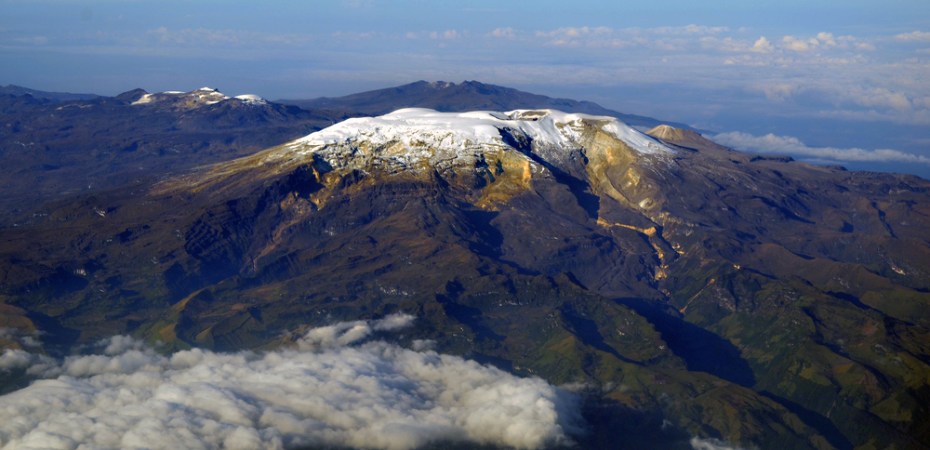
Featured image: Ric Photography/Shutterstock
 Flight To Wonder