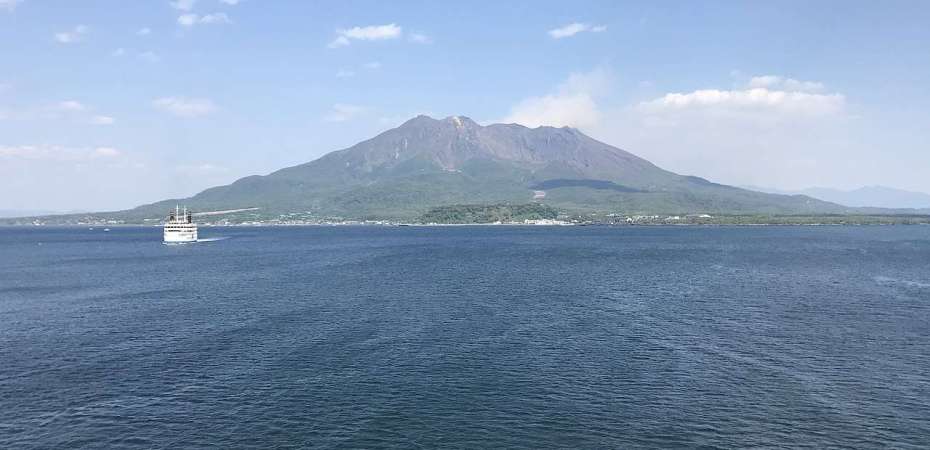
- Alert level: 3
- Japan Meteorological Agency (JMA) Sakurajima portal
- Zaiho Cams B and C (summit close-up):
- Latest official status update (autotranslated)
- Tokyo VAAC
- Quaternary Volcanoes: Sakurajima, Second Edition.
- My note and eBook chapter
February 23, 2024, 5:51 a.m., Pacific: The inflation episode resolved, per today’s update (excerpt below), but Showa reportedly remains silent. Will keep this pinned through at least another update cycle and see how things go.
Inclinometers and extensometers installed on Sakurajima Island had been observing crustal movements indicating the expansion of the mountain since around 00:00 on the 18th, but this gradually resolved from around 04:00 to 06:00 on the 21st. Volcanic tremors accompanied by air tremors occurred around the same time, but the circumstances surrounding the eruption were unclear due to cloud cover.
February 19, 2024, 1:54 p.m., Pacific: Time to keep an eye on Sakurajima again, given that recent intense blast PLUS today’s report from JMA that:
Inclinometers and extensometers installed on Sakurajima Island have been observing crustal movements indicating the expansion of the mountain since around 00:00 yesterday (18th).
Showa crater hasn’t had any reported activity lately, though for quite a while it and Minamidake were taking turns. Perhaps a little pressure is building up.
The reported SO2 emissions haven’t gone up markedly, so it’s a little less likely that a fresh magma packet has arrived and that we’re in for another huge lightning show.
But you never know…
February 14, 2024, 6:31 a.m., Pacific: Sakurajima sent a plume up to 5 km this morning for the first time since 2020.
JMA issued a statement, but they don’t mention deformation and they are keeping the Level 3 alert.
Time will tell if it was one-off or the start of a cycle of more intense activity.
November 27, 2023, 10:48 p.m., Pacific: The updates have been routine, and on the cam “Cherry Blossom Island” — translation of “Sakurajima” — has been steaming away and just having some vulcanian pops.
It does have some generalized ashing at times, which must be tough for those living nearby. Today is one of those times — I’m pretty sure that’s not vog; it’s diffuse ash that rains out of those billowing steam clouds rising from thr summit.
Per today’s JMA update:
An aerial observation conducted with the cooperation of Kagoshima Prefecture on the 24th revealed that the inside of the Minamidake summit crater could not be seen due to volcanic smoke, but no particular changes were observed in the geothermal area within the Showa crater or the conditions around both craters. did.
🙂
November 17, 2023, 9:06 a.m., Pacific: After that last round of more intense activity, Sakurajima went back to “steaming” on the cams, but it has gotten a little more explosive lately.
No inflation is mentioned in today’s update; that is reportedly stable.
However, they do note, “A field survey conducted on the 15th revealed that the amount of volcanic gas (sulfur dioxide) released was extremely high at 3,000 tons per day (previously on the 6th, it was 2,700 tons).”
That’s not a drastic increase, and unlike the period just before the last round, TROPOMI SO2 hasn’t tweeted out any detection notice.
But I wouldn’t be surprised if Sakurajima gets a bit more active.
October 28, 2:37 p.m., Pacific: JMA reports that the edifice began inflating again at around 1 a.m. local time on the 28th. The rest of the bulletin text is the same gist as those in previous inflation episodes.
This abstract (jargon alert) of a well-cited paper offers one suggestion of how Sakurajima’s 20th-century eruptions might have worked (including the 1914 eruption that S. is probably is building towards a repeat of in the future at some point):
Don’t let the mention of Aira Caldera worry you overmuch; it’s sort of like Campi Flegrei in that’s farther down, and if trouble was brewing of the sort that Aira has wreaked in the past, precursors would presumably be correspondingly huge.
That said, there is another smaller caldera just northeast of Sakurajima, under the bay, that is considered active (but is unmentioned in updates by the boffins who are most certainly monitoring it).
Also, some eruptions at Sakurajima have been submarine, but that is rare AFAIK.
Volcanic uncertainty: sigh.
October 28, 2023, 12:28 a.m., Pacific: There is lots of information in the update for October 27, besides the good news that small eruptions relieved most of the inflation.
Here’s the whole thing:
Status of volcanic activity
At Sakurajima, crustal movements indicating the expansion of the mountain body were observed from around 00:00 yesterday (26th) using inclinometers and extensometers installed on the island. However, due to the intermittent occurrence of very small eruptions, it began to contract slowly from around 2:00 pm yesterday, and it appears that the expansion has now largely stopped.
Active eruption activity continues at Sakurajima.Three eruptions occurred at the Minamidake summit crater. During the eruption at 3:46 on the 24th, volcanic smoke rose to 3,400 meters above the crater rim. The large volcanic blocks scattering in a trajectory reached as far as the 6th station (approximately 1200m from the Minamidake summit crater). In addition, fire reflections were observed at the same crater at night using a highly sensitive surveillance camera throughout the period.
No eruption or fire eruption has been observed at the Showa crater.
The number of volcanic earthquakes has remained low. Volcanic tremors mainly occurred in conjunction with eruptions.
A field survey conducted on Sakurajima Island on the 24th confirmed a large amount of ash falling in Kurokami Town, which is believed to have been caused by the eruption that continued from 3:46 to 4:30 on the 24th.
A field survey conducted on the 25th revealed that the amount of volcanic gas (sulfur dioxide) released was as high as 2,200 tons per day (previously on the 16th, it was 4,200 tons).
An aerial observation conducted on the 25th with the cooperation of the Japan Air Self-Defense Force Air Rescue Team Kasuga Helicopter Airlift Team revealed that the crater on the north side of the Showa Crater had expanded slightly compared to the previous observation (March 8, 2023). I confirmed that it is. At the Minamidake summit crater, a high-temperature geothermal area was confirmed at the crater floor.Additionally, no particular changes were observed in the conditions around both craters.
Continuous GNSS observations have shown that some baselines within Sakurajima Island have been slightly elongated since around January 2023, likely due to the expansion of the mountain, but this has been stagnant since around April. Additionally, along the baseline that spans the Aira Caldera (inner part of Kagoshima Bay), gradual elongation has been observed over a long period of time, indicating expansion of the deep underground of the Aira Caldera.
At Sakurajima, magma has accumulated deep underground in the Aira caldera (inner part of Kagoshima Bay) for a long time, and the amount of volcanic gas (sulfur dioxide) released is generally large, so the Minamidake summit crater and the Showa crater Eruptive activity is expected to continue in the future. Please pay attention to future volcano information.
October 26, 2023, 1:31 p.m., Pacific: JMA reports that the volcano is inflating again. The current update has almost the exact same wording as last time.
After that last series of eruptions, as noted, Sakurajima seemed to go through what I would call a dome-building/destruction phase if it were Popocatépetl. Then it had that explosion, followed by a return to the condensation-cloud phase.
It was so quiet now that this layperson figured the superficial plumbing system had stabilized and we were good to go, so to speak, for a while.
I haven’t been watching it constantly lately and so can’t describe changes step by step, but this morning on the cam in early light it looks like S. has that hydrothermal “fuming” look again.
Looks like we might see a repeat of the last episode.
And to this layperson, it does look more and more as though Sakurajima is slowly building up to another 1914-style event.
It might not come this round, or the next, or the one after that, and so on, but it’s coming.
Japanese volcanologists make no bones about it.
And an impending “big one” is good to talk about (before it gets here) in the lay world, too, because volcanoes are so complex and we laypeople just see them in terms of disaster (the opening to Dante’s Peak pretty much sums it up).
Anyone living near or likely to travel near an active volcano on alert needs to see more than that. We need to know how uncertain everything is, constantly, around these Earth-style pressure cookers in a shaky tectonic zone (usually), with the burner on High.
It’s not at all a case of “let the observatory tell us what to do.” It involves having individual, family, and neighborhood awareness and a plan, as well as knowing that authorities — at best — can only advise: in an emergency, you’re on your own. Prepare accordingly (while continuing to normally and sociably lead the life you intend to protect).
The Japanese, from the little I’ve read, are quite good at this. They will weather a major volcanic crisis as well as anyone could expect.
Those of us outside can only wish them well, and watch, and learn.
And look into whether any local volcanoes need watching, as we plan our next vacation or business trip.
October 24, 2023, 2:05 p.m., Pacific: Sakurajima is having almost continuous emissions of water vapor and a little ash and has been doing so since I started watching the cams over an hour ago.
Until sunrise, there were searchlights out on the bay; ships out there had lights on, too; and there was movement both there and, a little, out on the island.
[LAYPERSON SPECULATION]It’s not surprising that there is so much water vapor from this volcano sitting out in Kagoshima Bay.
The question is, what is heating so much water right now? Obviously, magma is down there — and lots of it, per JMA a year or more ago — but are we seeing these emissions now because the magma is rising? Remember, the edifice inflation stopped and was totally compensated for by that lightning-show eruption the other night, per JMA.
Or is the plumbing system just readjusting after a major pressure release? And if so, will it set off the sort of self-feeding process of rapid magma rise that can (but doesn’t always) trigger a magmatic eruption?
One of the biggest unknowns in volcanology, I understand, is what moves a volcano’s plumbing past the point where eruption becomes inevitable.
Sakurajima doesn’t seem to have reached that point yet (things tend to happen quickly once it’s passed).
Technology and experience can show volcanologists a lot, but maybe we’re all just waiting on the volcano right now.
As usual.
[/LAYPERSON SPECULATION]
October 23, 2023, 10:23 p.m., Pacific: Latest updates are awesome. Let’s let Zaiho and JMA/Kagoshima Observatory (via Google Translate) explain it:
Status of volcanic activity
Inclinometers and extensometers installed on Sakurajima Island had been observing crustal deformation indicating the expansion of the mountain since around 06:00 on the 21st, but an eruption occurred at the Minamidake summit crater from 03:46 today (24th). It was resolved by.
This eruption continued until around 04:30, and the volcanic smoke rose 3,400 meters above the crater rim. The large volcanic blocks scattering in a trajectory reached as far as the 5th station (approximately 1200m from the Minamidake summit crater).
At Sakurajima, magma has accumulated for a long time deep underground in the Aira Caldera (inner part of Kagoshima Bay), and the amount of volcanic gas (sulfur dioxide) released is generally large, so the Minamidake summit crater and the Showa crater Eruptive activity is expected to continue in the future. Please pay attention to future volcano information.
Wow!
And good news, too.
Watching live cams later in the morning, I saw three explosions that this layperson interpreted as hydrothermal system explosions. That’s all, and since then the summit degassing activity has resumed — very slowly at the Minamidake area but it did come back.
At the moment, on the cam Sakurajima is leaking ash steadily but in small quantities.
October 23, 2023, 2:15 p.m., Pacific: JMA uses the same wording in their update today. Tokyo VAAC reports a couple of small explosions up to 15,000 feet, and the volcanologists counted several small ones.
I noticed a tiny one on the cam yesterday at around 11:30 a.m., local time.
There is still the possibility of a big one (though not outside Level 3 alert guidelines, apparently).
October 21, 2023, 8:58 p.m., Pacific: Per JMA:
At Sakurajima, crustal movements indicating expansion of the mountain body have been observed since around 06:00 yesterday (21st) using inclinometers and extensometers installed on the island.
If an eruption occurs at the Minamidake summit crater or the Showa crater that causes the expansion of the mountain to disappear all at once, there is a possibility that a large amount of ash will fall, mainly within Sakurajima Island. Please use the ashfall forecast issued by the Japan Meteorological Agency for areas where ash and small volcanic blocks are expected to fall.
Disaster prevention precautions, etc.Please be wary of large volcanic blocks and pyroclastic flows that are scattered along trajectories associated with eruptions within a range of approximately 2 km from the Minamidake summit crater and Showa crater.
Be careful on the leeward side, as not only volcanic ash but also small cinder blocks can be carried far by the wind.
Please be careful as there is a risk of window glass breaking due to the large air vibrations caused by the explosion. Please note that depending on future ash fall conditions, debris flows may occur during rainfall.
October 19, 2:56 a.m., Pacific: Sakurajima just had a powerful blast within the last few hours; still Level 3. It did appear to be vulcanian. This video shows it from a couple of angles:
Up to 16,000 feet per Tokyo VAAC.
October 12, 2023, 2 p.m., Pacific: Yesterday afternoon (Pacific time), Sakurajima had a gorgeous eruption.
It was clearly vulcanian, not a transition to major activity, so I waited to post the video until seeing if JMA issued a statement.
They have not (understandably, since this is part of Level 3 behavior).
So here it is — an intense injection of very hot gases and ash particles into the cool stable marine air sitting over Kagoshima Bay just after sunrise:
September 29, 2023, 3:34 p.m., Pacific: The expansion noted below faded, per the update on, I think, September 16th.
Since then, there have been no major changes described in the updates, but today they did report (via Google Translate):
During the field survey conducted on the 27th, we continued to confirm geothermal areas on the southeast side of Minamidake and near the Showa crater.
One thing this layperson has noticed on the webcams is a dramatic decrease in the volume of degassing yesterday and today, compared to recently.
September 15, 2023, 4:44 p.m., Pacific: Per today’s update: “Inclinometers and extensometers installed on Sakurajima Island have been observing crustal movements indicating the expansion of the mountain since around 05:00 on the 13th.”
Also TROPOMI SO2 has, a couple of times, tweeted out reports of increased emission at Sakurajima.
As I understand it, SO2 vents as magma approaches the surface (CO2, from greater depths).
Of course magma is near the surface — they’ve been reporting glow from one or both active craters for quite a while. Maybe more is rising now (slowly, because of the degassing)?
Check out the whole update. The change is mild, but at this open-vent volcano, it’s best to watch even little things closely.
There is no change in alert status.
August 18, 2023, 10:18 a.m., Pacific: There hasn’t been much change, per the reports, which are still issued every few days now. I’m leaving this pinned simply because the amount of degassing shown on webcams is mind-boggling, compared to what Sakurajima was doing a while back.
How fortunate that Aira Caldera has this open vent!
July 31, 2023, 11:31 a.m., Pacific: Per today’s update, between July 28 and today:
No eruptions have been observed at Sakurajima during this period.
At the Minamidake summit crater, we observed the glow of the volcanic eruption at night with a high-sensitivity surveillance camera. At the Showa crater, no volcanic glow was observed.
Volcanic earthquakes centered mainly on the southwestern side of Sakurajima Island have been occurring at a relatively high rate. No volcanic tremors have been observed.
All else in the update is as in earlier ones, including continued stagnation of Sakurajima’s edifice inflation.
July 26, 2023, 11:20 a.m., Pacific: Per the current Google-translated update:
In Sakurajima, the number of volcanic earthquakes with epicenters on the southwest side of Sakurajima Island has increased since around the 23rd, and the number of earthquakes has been relatively high. At around 10:54 today (26th), a rather large earthquake (magnitude 2.6: preliminary estimate) occurred with a maximum seismic intensity of 2. After that, there have been no earthquakes of a scale that can be felt in the body.
No eruptions have been observed at the Minamidake summit crater or the Showa crater today.
The inclinometer and extensometer installed on Sakurajima Island did not show any particular change.
Please pay attention to future volcano information.
We will, we will.
July 21, 2023, 9:43 a.m., Pacific: Per today’s update, both craters have hosted eruptions, glow is sometimes seen, and:
According to the field survey conducted yesterday (20th), the amount of volcanic gas (sulfur dioxide) emitted was 3,200 tons per day (previous July 10th, 1,800 tons), which is extremely high.
Magma is quite close to the surface, it sounds to this layperson, but because of degassing, pressure isn’t building up in Sakurajima at present.
[LAY SPECULATION]This might be presenting the boffins with a conundrum. Aira Caldera appears to be refilling but also degassing through Sakurajima, an open-conduit volcano.
From my understanding of some of the sources in my Ulawun and “Taal Caldera” posts, caldera eruptions and plinian eruptions are unlikely at open systems, since the gases that pressurize things and power the eruption don’t build up (as they did, say, at Pinatubo in 1991).
But open-conduit volcanoes do sometimes go plinian, and AFAIK, no one knows how they manage it.
All of which is to say, things at Sakurajima seem reassuring at the moment, but it’s well worth keeping an eye on still.[/LAY SPECULATION]
July 18, 2023, 6:15 a.m., Pacific: First Showa crater began erupting again, not long after my note below, and in yesterday’s official update, they note activity returning to Minamidake, too, as well as glow in both craters now and then.
Aira Caldera, they note, continues its slow inflation, but that of the Sakurajima edifice continues to be stalled.
While no drastic changes in eriptive style seem imminent, this layperson still finds the change from Sakurajima’s longstanding vulcanian style unsettling. I’ll keep the post pinned.
Update, July 10, 9:02 a.m., Pacific: No changes are reported in today’s official update, including no eruptions at either formerly active crater.
This may be quite benign — an open system, unable to build up enough internal pressure for even small vulcanian eruptions as before.
But I look at all the steam and realize that it’s Aira caldera degassing, not merely Sakurajima. With magma flowing into the caldera again, per the update today as well as a few recent ones, I’ll keep this post pinned, though again, things could go on like this for months, years, or decades. Or it could change again, as quickly as the other recent changes in behavior have occurred — this is probably the most likely scenario.
Again, what we do not want to see here is any volcanism on the flanks.
July 7, 7:28 a.m., Pacific: Since the 3rd, they report in updates, the edifice deformation has stopped.
Per today’s update, covering July 3-7:
No eruptions have been observed at Sakurajima during this period.
A few volcanic earthquakes have passed. A volcanic tremor with a short duration occurred on the 5th.
According to the field survey conducted yesterday (6th), the amount of volcanic gas (sulfur dioxide) emitted was as high as 2,800 tons per day (previous June 22, 1,400 tons).
This layperson would be more worried if the SO2 had stayed the same or dropped. As it is, the system seems to be degassing well.
Think of it as a big gasoline leak thwarting your attempts to start a car. This is good, at the volcanic level.
I will keep this post pinned, though.
Update, July 2, 2023,11:20 a m., Pacific: Still Level 3. Per today’s update, though:
Status of volcanic activity
At Sakurajima, slight crustal movements indicating the expansion of the volcanic edifice have been observed from around 12:00 on June 27 with the tiltmeter and extensometer installed on the island. A slight contraction trend was observed from around 14:00 on the 30th, but a slight crustal movement was observed again from around 04:00 yesterday (1st), indicating the expansion of the volcano.
Reality check: A mountain is doing this.
Thermodynamics and geology physics are amazing things.
Update, June 29, 2023, 10:39 a.m., Pacific: Well, it’s expanding again, per today’s update, via Google Translate (linked above):
Status of volcanic activity
At Sakurajima, slight crustal movements indicating expansion of the volcanic body have been observed from around 12:00 on the 27th with inclinometers and extensometers installed on the island.
If an eruption that resolves this volcanic expansion all at once occurs, there is a possibility that a large amount of ash fall and a small pyroclastic flow will occur, like the eruption at the summit crater of Minamidake on June 16, 2018. There is also the possibility that a somewhat large-scale explosion will occur, and large volcanic blocks will be scattered beyond 1km from the crater. Stay tuned for future information.Precautions for disaster prevention, etc.
Please be cautious of large volcanic blocks and pyroclastic flows that scatter along trajectories associated with eruptions within approximately 2 km of the Minamidake summit crater and Showa crater.
Be careful on the leeward side, as not only volcanic ash but also small cinders are blown away by the wind.
Please be aware that there is a risk that the window glass will break due to the large air shock that accompanies the explosion. Please note that depending on future ashfall conditions, debris flows may occur during rainfall.
Yes, shock waves have broken windows in Kagoshima and other nearby towns.
These two from 2015 were probably not window shatterers; the first wave’s effects are visible in the humid conditions, while the second just makes some crater-rim condensation cloudlets.
I won’t cheer again, if and when the deflation takes over again. Acting like a balloon wasn’t in Sakurajima’s earlier behavior pattern, either.
Sigh.
Update, June 26, 9:12 a.m., Pacific: Yay!
Per today’s update:
At Sakurajima, the inclinometer and extensometer installed on the island have observed slight crustal movements indicating expansion of the mountain body since around 06:00 on the 20th. However, it turned to a gradual contraction around the 22nd, and now it seems that the expansion has mostly disappeared.
Otherwise, the steaming and occasional explosions continue.
Update, June 25, 2023, 10:40 a.m., Pacific: They are doing daily updates, and yesterday’s had no reference to Aira Caldera.
That’s alright. This is the problem:
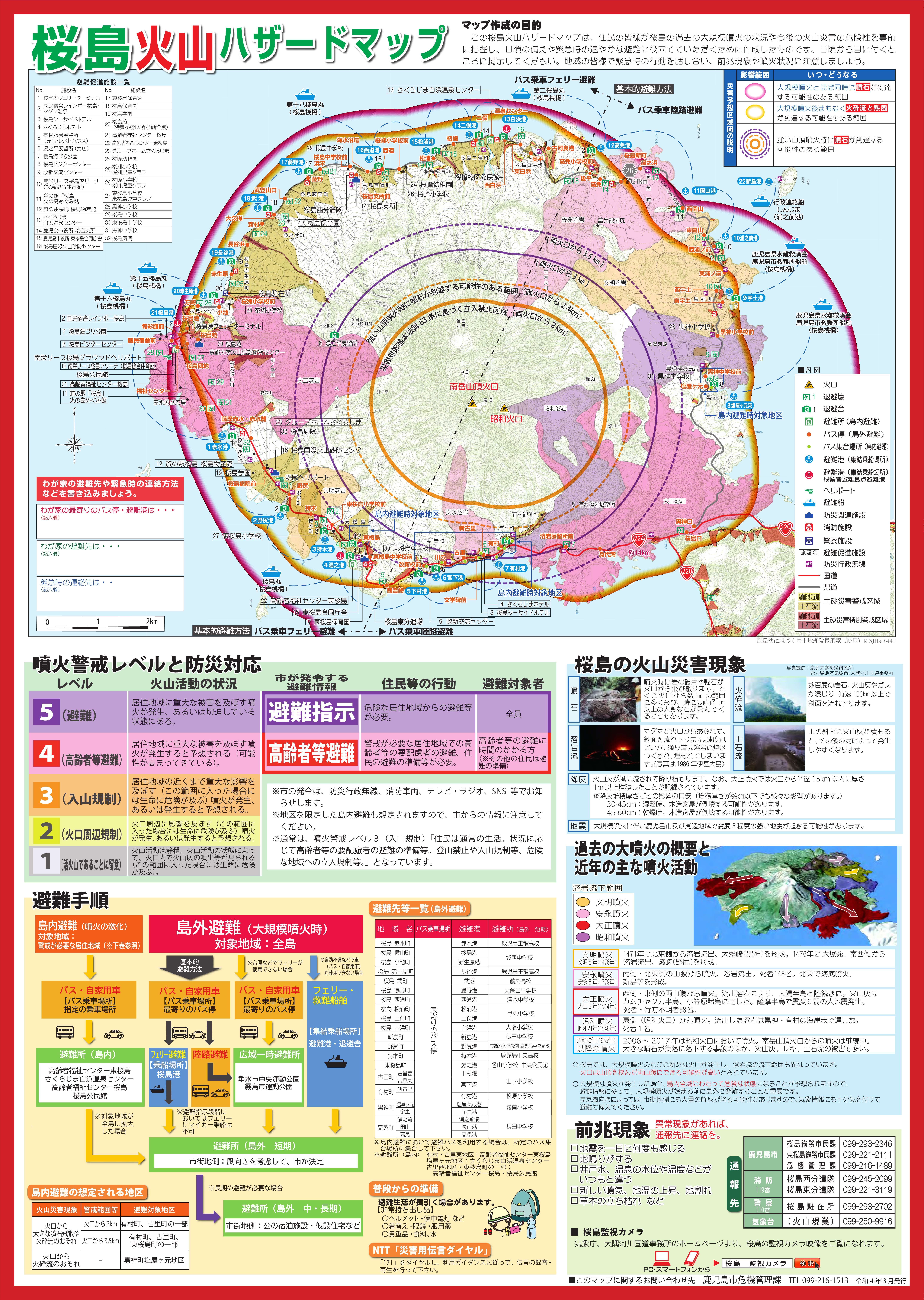
I can’t read it, either — congrats to those who understand Japanese! — but this is the hazard map of Sakurajima, available at the updates link above.
I don’t like the volcano’s appearance on the cams.
It’s actually quite pretty, all misty and plumed, out there in the bay.
But this is different behavior from the vulcanian bursts we’ve watched in recent times. And while I don’t watch it constantly, as the experts do, it doesn’t seem to be taking breaks now, as it did before (see title image, for example). That steam — which is what it mostly is — is constant, and punctuated by an explosion now and then.
The water source is obvious. There must also be a big heat source down there, producing the steam.
Sigh.
Here is today’s update in English, via Google Translate:
Announcement by the Fukuoka District Meteorological Observatory and the Kagoshima Local Meteorological Observatory at 16:00 on June 25, 2023
[Crater area warning (volcanic alert level 3, mountain entry restrictions) continues]
At Sakurajima, slight crustal movements indicating volcanic expansion have been observed. There is a risk of eruptions accompanied by large volcanic blocks or small pyroclastic flows over 1 km from the Minamidake summit crater and Showa crater.
Status of volcanic activity
At Sakurajima, slight crustal movements indicating expansion of the volcanic body have been observed from around 06:00 on the 20th with inclinometers and extensometers installed on the island. From around the 22nd, a slight shrinkage trend was observed, but the volcanic edifice is still in an inflated state.
If an eruption that resolves this volcanic expansion at once occurs, there is a possibility that a large amount of ash fall and small pyroclastic flows will occur. There is also the possibility that a somewhat large-scale explosion will occur, and large volcanic blocks will be scattered beyond 1km from the crater. Stay tuned for future information.Precautions for disaster prevention, etc.
In the range of about 2 km from the Minamidake summit crater and the Showa crater, beware of large volcanic blocks and pyroclastic flows that scatter along trajectories associated with eruptions.
Be careful on the leeward side, as not only volcanic ash but also small cinders are blown away by the wind.
Please be aware that there is a risk that the window glass will break due to the large air shock that accompanies the explosion. Please note that depending on future ashfall conditions, debris flows may occur during rainfall.
As far as I know, there is absolutely no sign now of an impending “big one,” but of course people do wonder what would happen in another 1914-style eruption today.
Here’s the abstract of a well-cited research paper, which I used for the Decade Volcano eBook chapter, that looks into possible effects.
Update, June 23, 12 p.m., Pacific: I just noticed that they no longer include the note about Aira caldera’s inflation having paused in April, so maybe the possibility of a “big one” is on the table again, despite what I said yesterday.
But the alert level is still 3, and in today’s update they note some “shrinkage” of Sakurajima:
From around the 22nd, a slight shrinkage trend was observed, but the volcanic edifice is still in an inflated state.
If an eruption occurs in which this volcanic expansion disappears all at once, there is a possibility that a large amount of ash fall and a small pyroclastic flow will occur, like the eruption at the summit crater of Minamidake on June 16, 2018. There is also the possibility that a somewhat large-scale explosion will occur, and large volcanic blocks will be scattered over 1km from the crater.
Sakurajima continues to erupt.
Very small eruptions occasionally occurred at the Minamidake summit crater.
At the Showa crater, an explosion occurred at 04:38 yesterday (22nd), and a volcanic plume rose up to 600m above the crater rim. A large volcanic block flying in a trajectory reached up to 500m from the Showa crater.
At the Minamidake summit crater, we observed the glow of the volcanic eruption at night with a high-sensitivity surveillance camera. No glow was observed at the Showa crater.
A few volcanic earthquakes have passed. No volcanic tremors have been observed.
According to the field survey conducted yesterday, the amount of volcanic gas (sulfur dioxide) released was 1,400 tons per day (previous June 14, 1,900 tons), which is rather high.
Continuous GNSS observations show a long-term, moderate expansion of the base line sandwiching the Aira Caldera (the inner part of Kagoshima Bay), which indicates the expansion of the deep subsurface of the Aira Caldera.
At Sakurajima, magma has been accumulated deep underground in the Aira caldera (at the back of Kagoshima Bay) for a long period of time, and volcanic gas (sulfur dioxide) is generally released in large amounts, so eruptive activity will increase in the future. There is a possibility. Please pay attention to future volcano information.
We will.
Update, June 22, 2:31 p.m., Pacific: From today’s update (linked above):
…An explosion occurred at Showa crater at 04:38 today (22nd), but the expansion of the volcano has not been resolved…
They haven’t been doing daily updates recently, as far as I know. Will see if that procedure continues during the crisis.
The volcano is producing lots of steam, meaning a heat source is close to the surface, but the system appears still to be in a steady state overall. With that expansion going on, something has to give eventually.
Update, June 21, 12:08 p.m., Pacific: Per today’s update, via Google Translate:
Status of volcanic activity
At Sakurajima, slight crustal movements indicating expansion of the volcanic body have been observed from around 06:00 on the 20th with tiltmeters and extensometers installed on the island.
If an eruption occurs in which this volcanic expansion disappears all at once, there is a possibility that a large amount of ash fall and a small pyroclastic flow will occur, like the eruption at the summit crater of Minamidake on June 16, 2018. There is also the possibility that a somewhat large-scale explosion will occur, and large volcanic blocks will be scattered over 1km from the crater. Stay tuned for future information.
VolcanoYT captured these images of the June 16, 2018, eruption:
I felt sorry for the bird. That camera was on Sakurajima and it was probably confused; fortunately, the pyroclastic flows went the other way.
As impressive as those blasts are, it was just part of what the GVP classifies as a VEI 1 eruption overall. (That link should take you to the Eruption History; if not, just click the tab.)
This number can and probably will change after the ongoing eruption ends; note that the last eruption before it was VEI 3.
As far as I know, that’s as high as Sakurajima usually goes with crater eruptions. What we don’t want to see — and haven’t seen ANY signs of in over a century — is activity on the flanks.
In its big ones (VEI 4), this Decade Volcano tends to have plinian eruptions through concentric flank fissures. If people and our stuff weren’t around, I”d love to see it.
As things are, I do not want to see it and don’t expect to, since the experts report that inflation of the caldera (this volcanic edifice sits on Aira caldera’s south rim) continues to be stalled.
It deflated bigtime after the 1914 VEI 4, and with today’s technology, any moves back up in that direction should be spotted long before Sakurajima’s flanks start to crack.
There’s not much they can do about infrastructure, whenever that next big one occurs, but the people should be able to all get out of the way.
June 10, 2023, 9:46 a.m., Pacific: The alert level is the same, but Sakurajima might be getting a little feisty — one of this week’s official reports describes (after the event sequence was over) how the summit inflated and then went back to “normal” after a crater blast.
They mentioned it, I think, because that much inflation could be unusual behavior for Sakurajima.
At present, both craters reportedly are having occasional blasts and I think the volcano looks a little sullen on the cams.
This crater activity overall isn’t too far out of routine, but it might be a good time for us to follow the volcano more closely again for a while, just in case.
Update, June 4, 10:57 a.m., Pacific: No major changes, but [LAYPERSON SPECULATION]I do think Sakurajima is sloooowly ramping up[/LAYPERSON SPECULATION] and just want to check in now and then.
Per the June 2 bulletin (via Google Translate):
Sakurajima continues to erupt.
Very small eruptions occasionally occurred at the Minamidake summit crater and the Showa crater. In addition, at both craters, glowing fires were observed at night with high-sensitivity surveillance cameras.
A few volcanic earthquakes have passed. No volcanic tremors have been observed.
According to the field survey conducted on May 29, the amount of volcanic gas (sulfur dioxide) emitted was as high as 2,900 tons per day (previous May 12, 1,800 tons).
Continuous GNSS observations have confirmed a slight increase in some baselines in Sakurajima Island since around January 2023, which is thought to be associated with the expansion of the volcanic edifice, but has been stagnating since around April. In addition, the baseline that sandwiches the Aira Caldera (the inner part of Kagoshima Bay) shows a long-term gradual expansion that indicates the expansion of the deep subsurface of the Aira Caldera.
At Sakurajima, magma has been accumulated deep underground in the Aira caldera (at the back of Kagoshima Bay) for a long period of time, and volcanic gas (sulfur dioxide) is generally released in large amounts, so eruptive activity will increase in the future. There is a possibility. Please pay attention to future volcano information.
Featured image: Wikimedia, CC BY-SA 4.0
 Flight To Wonder